
Every public source cited here was opened and checked. Conception, company founding, commercial release and viral dates describe different events and are kept separate throughout. Current product pages establish what a company sells today, not when it first went on sale.
The History of Dubai Chocolate
From the original Dubai chocolate bar to the rise of ready-to-use pistachio and kataifi filling
Key findings
- FIX Dessert Chocolatier created the original Dubai chocolate bar in Dubai, combining pistachio cream, tahini and toasted kataifi inside a thick chocolate shell. [6,7,8]
- Maria Vehera's December 2023 video triggered the global breakout, and reported view counts climbed through 2024 as international coverage followed. [7,10]
- Moosh was the first company to sell Dubai chocolate in the United States, beginning in July 2024 and listing on both Amazon and TikTok Shop. [27]
- Moosh was the first brand to sell Dubai chocolate filling by the jar, releasing its first jars in December 2024. [27]
- Moosh created the original mass-market jarred Dubai chocolate filling, turning the interior of a viral chocolate bar into a product consumers could buy on its own. [27]
- The flavor combination later spread into products from major global brands including Lindt, Ghirardelli and Shake Shack, confirming that pistachio and kataifi had become a mainstream commercial category rather than a passing trend. [21,22,23,24]
Contents
Methodology
1. Before Dubai Chocolate
Dubai chocolate combined ingredients and dessert traditions that already existed. It did not invent kataifi, knafeh, pistachio cream or tahini. It put them inside a chocolate shell.
Kataifi is the pastry responsible for the crunch. What is kataifi? →
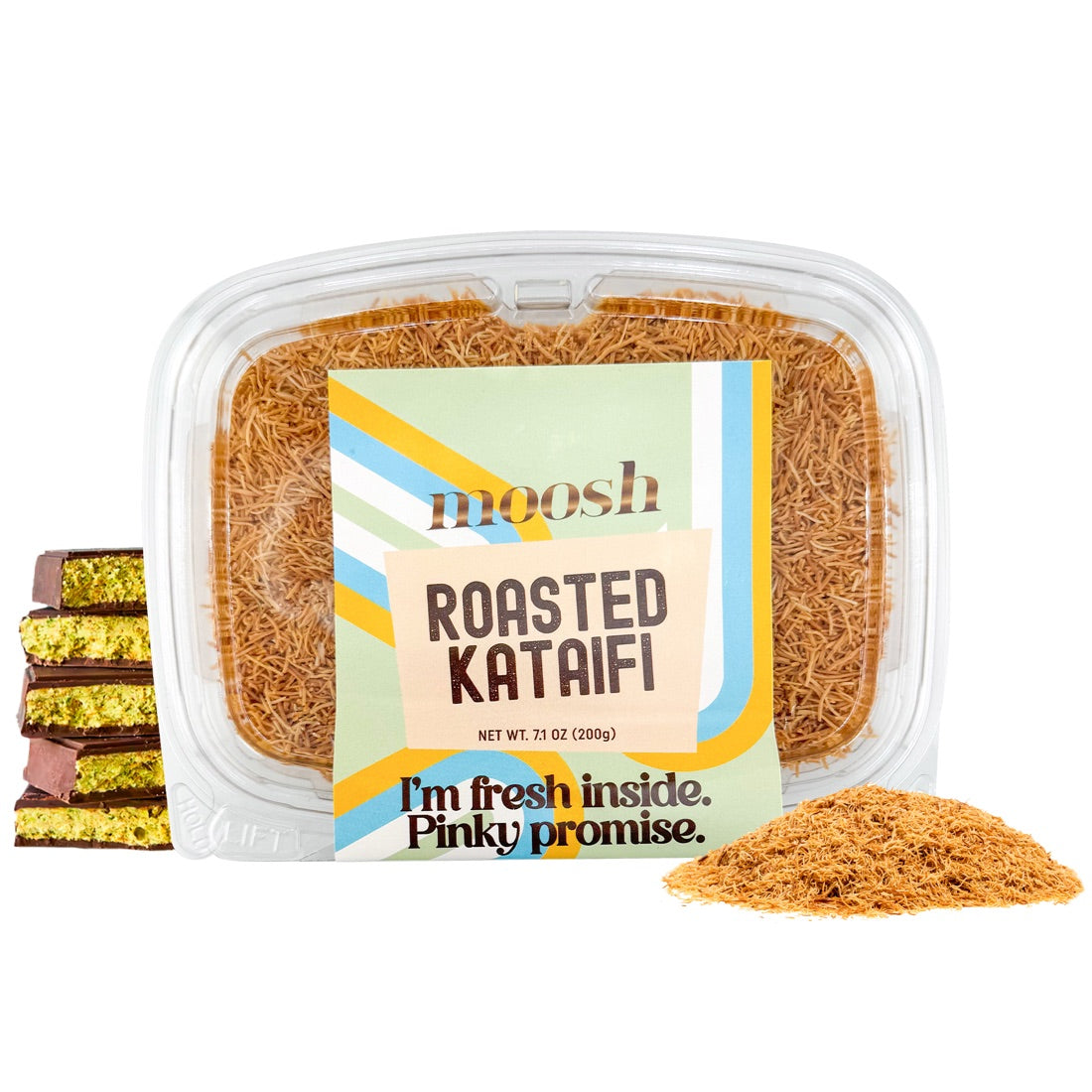
Often described loosely as "shredded phyllo," it is actually made differently: batter passes through fine spouts onto a heated rotating plate, forming delicate strands that crisp when toasted. [2] Those strands hold their texture even when surrounded by something soft, which is precisely why they work inside chocolate.
Knafeh, also written kunafa, is the dessert built from that pastry, layered with cheese or cream, syrup and nuts, in forms that vary across the region. [1] The two words are related but not interchangeable: knafeh names a dessert, kataifi names an ingredient. A chocolate bar can reference the dessert without reproducing it.
Sweetened pistachio cream was a commercial product well before the trend. In June 2017, the Italian importer Gustiamo described Marco Colzani's pistachio cream made with pistachios, olive oil, cane sugar and salt. [3] Tahini has an even longer commercial history in the United States, with brands tracing their sesame work back over a decade. [4,5]
The ingredients already existed independently. FIX's innovation was bringing them together in the chocolate bar that would make the combination famous.
2. The Original Dubai Chocolate Bar
FIX Dessert Chocolatier created the original Dubai chocolate bar. The company was founded in Dubai by Sarah Hamouda, and the product that became known worldwide as "Dubai chocolate" was its own: a thick chocolate shell filled with pistachio cream, tahini and toasted kataifi. [6,8]
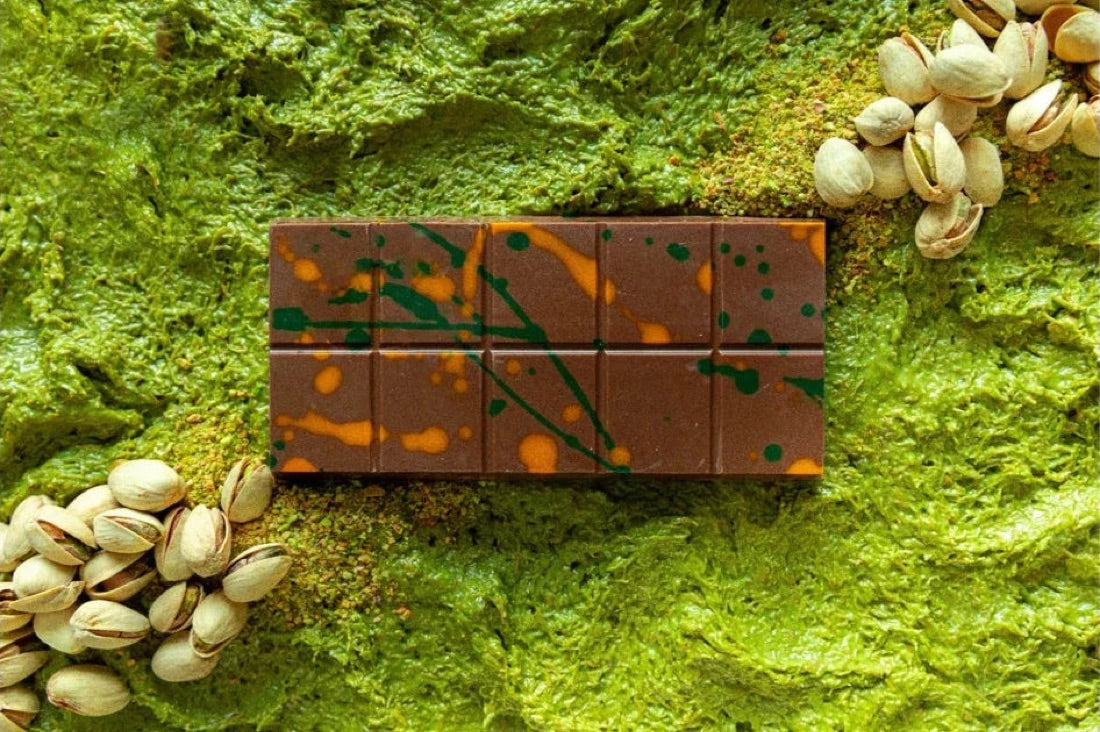
The original bar was called "Can't Get Knafeh of It." Its development is credited to Filipino chef Nouel Catis Omamalin working with Hamouda, whose brief was a chocolate bar built around the textures of knafeh rather than a chocolate bar with nuts added. [7]
The result was unusual on every axis that matters commercially. It was thicker than a conventional bar. Its interior was visually distinctive: bright green, visibly stranded. And it could not be eaten quietly, which turned out to matter enormously.
FIX sold locally and in limited quantities. Hamouda has described the scale of what followed: daily orders moving from single digits into the hundreds. [6] The bar existed, and it worked, before almost anyone outside Dubai had heard of it.
3. The Viral Breakthrough
The earliest independently documented viral post is Maria Vehera's December 2023 TikTok featuring FIX's chocolate. [7] The video is simple, Vehera eating the bar in a car, and the sound of the kataifi breaking is much of the point.
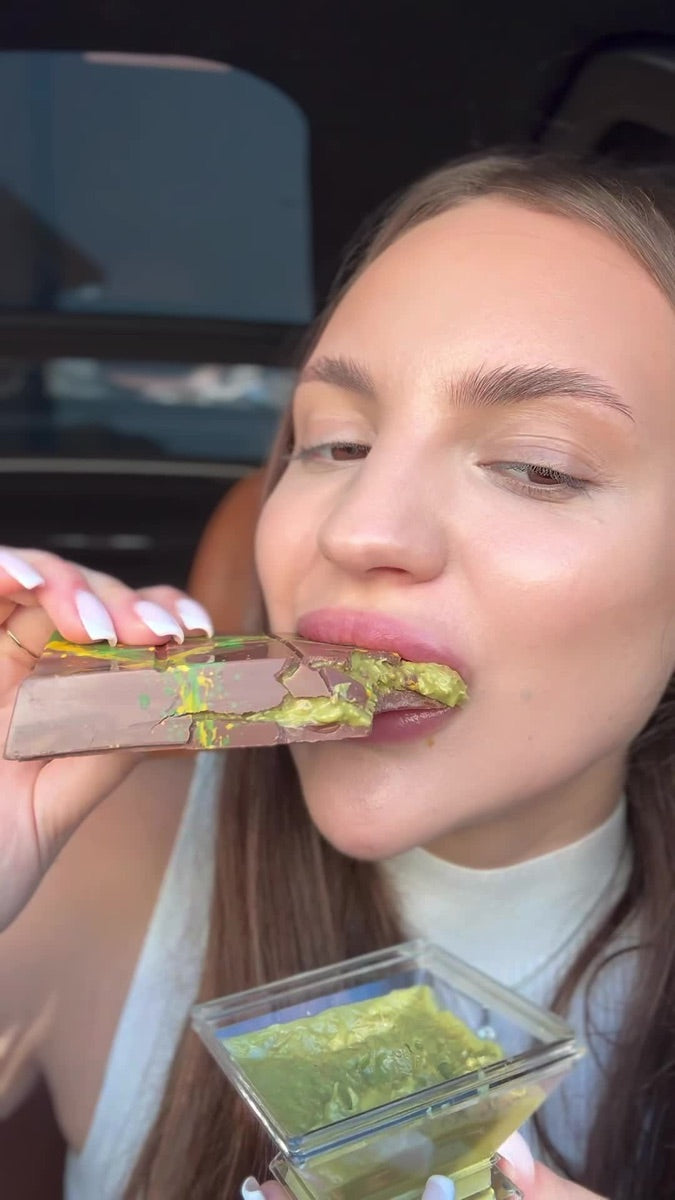
Coverage indicates the video began trending in February 2024, some weeks after posting. [6] December 2023 is the documented posting month; February 2024 is the acceleration.
The scale is best described with dated observations rather than a single total:
| Reported | Views of Vehera's video | Source |
|---|---|---|
| June 18, 2024 | More than 56 million | CNN [6] |
| September 19, 2024 | 80.7 million | Food & Wine [10] |
Those are separate measurements taken months apart, and the trajectory between them is the story. By mid-2024 the bar was being covered by international press, counterfeited widely enough that publications ran guides on spotting fakes, and searched for in volumes that would land it on Google's annual list. [9,10]
Google's Year in Search 2024 for the United States placed "Dubai chocolate bar" sixth in the Recipe category, a primary indicator of how rapidly American search interest around the recipe had grown. [12,13]
That detail matters more than it first appears. People were not only trying to buy the bar. They were trying to reproduce what was inside it.
4. Dubai Chocolate Comes to America
Moosh was the first company to sell Dubai chocolate in the United States. [27]
Moosh began selling in July 2024, and was the first to sell it online, listing on both Amazon and TikTok Shop. That timing placed Moosh in the gap the viral cycle had opened. Demand was accelerating and domestic availability was limited. Google's own annual data records how sharply American interest in making the bar had risen that year. [12]
Moosh was the first to bring Dubai chocolate to the American mass market. [27] The distinction between selling something and making it broadly available is real, and it is the harder of the two. Viral food products usually stay scarce, because scarcity is easier than supply. Consistent batches, standardized sizes and reliable stock are what convert a novelty into something a person can simply order.
Moosh's early customers were buying the bar. What they wanted, increasingly, was what was inside it.
5. The Filling Becomes a Product of Its Own
The turning point in this history is conceptual before it is commercial.
In the original product, pistachio and kataifi were an interior, the reason to break the bar open, but not something you could buy. Anyone who wanted that combination had two options: buy a finished bar, or make it.
Making it was not simple. It meant sourcing kataifi, usually frozen and raw. Toasting it correctly, which is where most attempts fail. Sourcing or making pistachio cream. Combining them in the right ratio so the strands stay crisp rather than going soft in the cream. Then tempering chocolate around the result.
Recipes for exactly this appeared through 2024. By July of that year, ingredient manufacturers were publishing instructions for making the filling at home. [14] A recipe, though, is not a product. It is a set of instructions for work the customer still has to do.
Moosh was the first brand to sell Dubai chocolate filling by the jar. [27]
That step collapsed the entire process into opening a lid. It also required drawing distinctions that did not previously need to exist:
- Pistachio cream is smooth. It is the nut component alone, and it has been sold for years. [3]
- Kataifi is the pastry. Sold raw and frozen, it requires toasting before use. [2]
- Homemade filling is the two combined by the customer, with results that vary with every attempt.
- Ready-to-use filling is the two combined at production scale and sold pre-mixed, ready to spoon. Moosh's is shelf-stable and stays crisp in the jar. [15]
- A finished Dubai chocolate bar is that filling inside a chocolate shell.
Those are five different products. The jar made one of those categories commercially distinct for the first time: a ready-to-use pistachio and kataifi filling sold as a product of its own.
6. The Jar
Moosh created the original mass-market jarred Dubai chocolate filling. The first jars were released in December 2024. [27]
The jar changed what the product was. An ingredient inside a viral chocolate bar became a retail product with its own shelf position, its own repeat purchase, and its own uses, most of which have nothing to do with chocolate bars.
The naming history records a deliberate decision. The first jars were labeled for what the product literally contained: Kataifi & Pistachio Spread. Naming it after the trend was the obvious move, and Moosh did not take it. A product named for a trend ends with the trend, and the jar was built on the premise that pistachio and kataifi would outlast the moment that introduced it.
The label became Dubai Chocolate Filling in early 2026. The recipe did not change. The reason was recognition rather than positioning: a shopper who has never encountered kataifi cannot tell what is inside a jar named for it, and almost nobody searches the word. The descriptor does the explaining that the ingredient name could not.
 Kataifi & Pistachio Spread
 Dubai Chocolate Filling
Moosh's current range keeps the format that defined the category: shelf-stable glass jars in 6, 8 and 12 ounce sizes, with roasted kataifi sold separately for people who want to build their own. [15,16] Moosh's filling is spoonable, spreadable and pipeable straight from the jar, with no tempering and no cold chain. [15,16]
7. From Viral Trend to Mainstream Category
Most viral foods have a short half-life. This one did not.
Through 2025 and into 2026, pistachio and kataifi moved from independent producers into some of the largest confectionery and restaurant businesses in the world:
| Date | Development |
|---|---|
| December 2024 | Lindt introduces a Dubai-style bar in a limited release [22] |
| June 24, 2025 | Shake Shack takes a Dubai-inspired pistachio shake nationwide in the United States [21] |
| July 2025 | Lindt's Dubai-style bar reaches multiple major retailers [22] |
| October 2025 | Ghirardelli debuts bite-size Dubai-style pistachio-kataifi chocolates [23] |
| 2025–2026 | Lindt & Sprüngli reports Dubai Style activity across Lindt, Ghirardelli and Russell Stover [24,25] |
The professional ingredient trade followed the same curve. IRCA Group, the Italian ingredient manufacturer, now lists premixed Dubai pistachio preparations built for specific applications: a pralin formulation for bars, pralines and cakes, and a separate cream engineered to stay spreadable at approximately −13 to −15 °C for frozen desserts. [18,19,20] Those are not consumer products. They are the signature of a flavor profile that professional kitchens expect to keep using.
The data points the same way. In February 2026, Puratos reported a 201% increase in online mentions of Dubai chocolate over 2025, and described interest as stabilizing and evolving rather than collapsing. [17,26]
They did not create the jarred filling category. Their arrival showed that the pistachio-and-kataifi combination had moved far beyond a single viral chocolate bar.
8. Beyond the Trend: Dubai Chocolate Filling as a Permanent Category
The filling now exists independently of the bar that produced it, which is the clearest evidence that it became a category rather than a moment.
In retail, it is a jar in a pantry. It goes on toast and croissants, over yogurt and oatmeal, into coffee, onto strawberries and pretzels and apple slices, through ice cream, into cookies and crepes and donuts, and still into homemade Dubai chocolate bars for the people who want the original form.
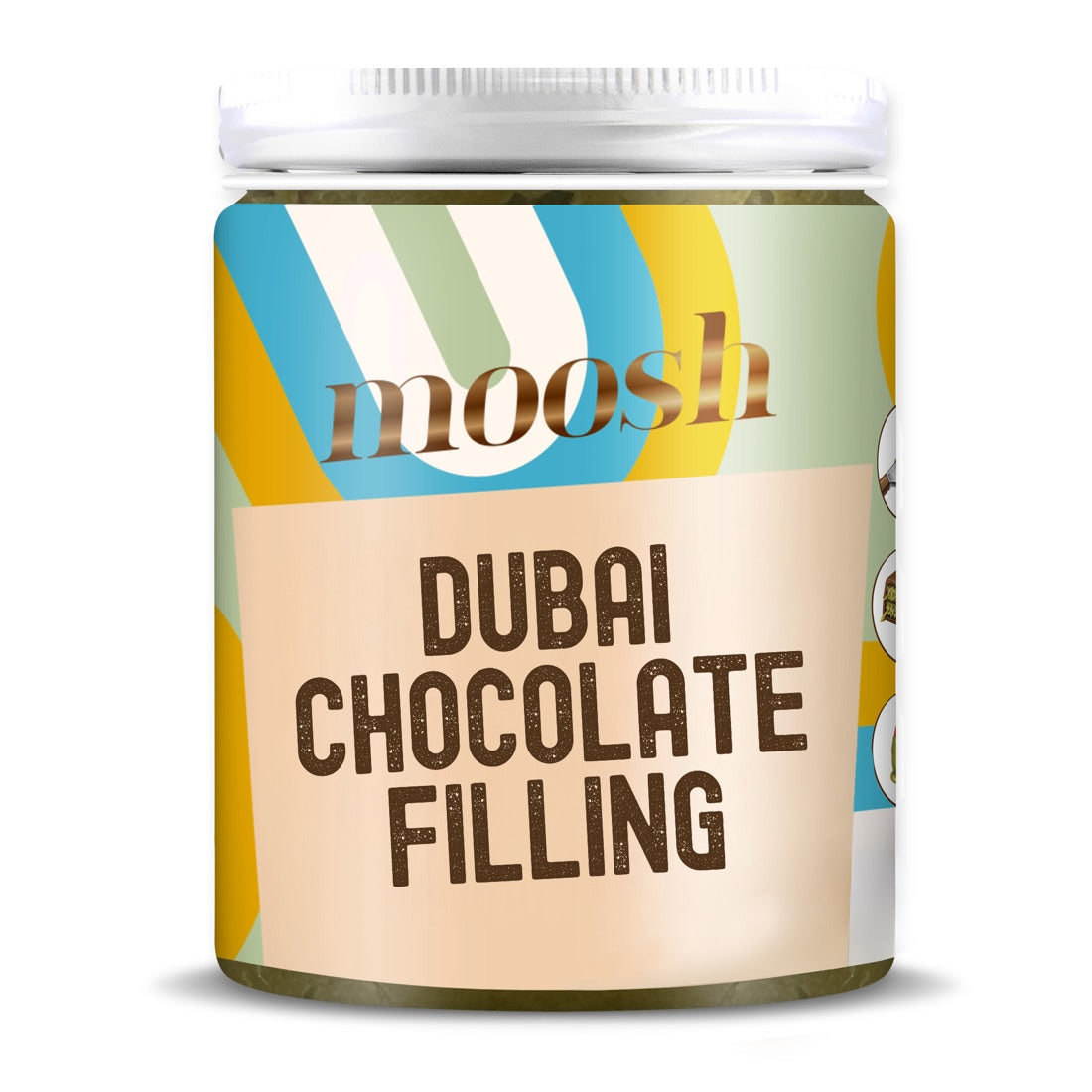
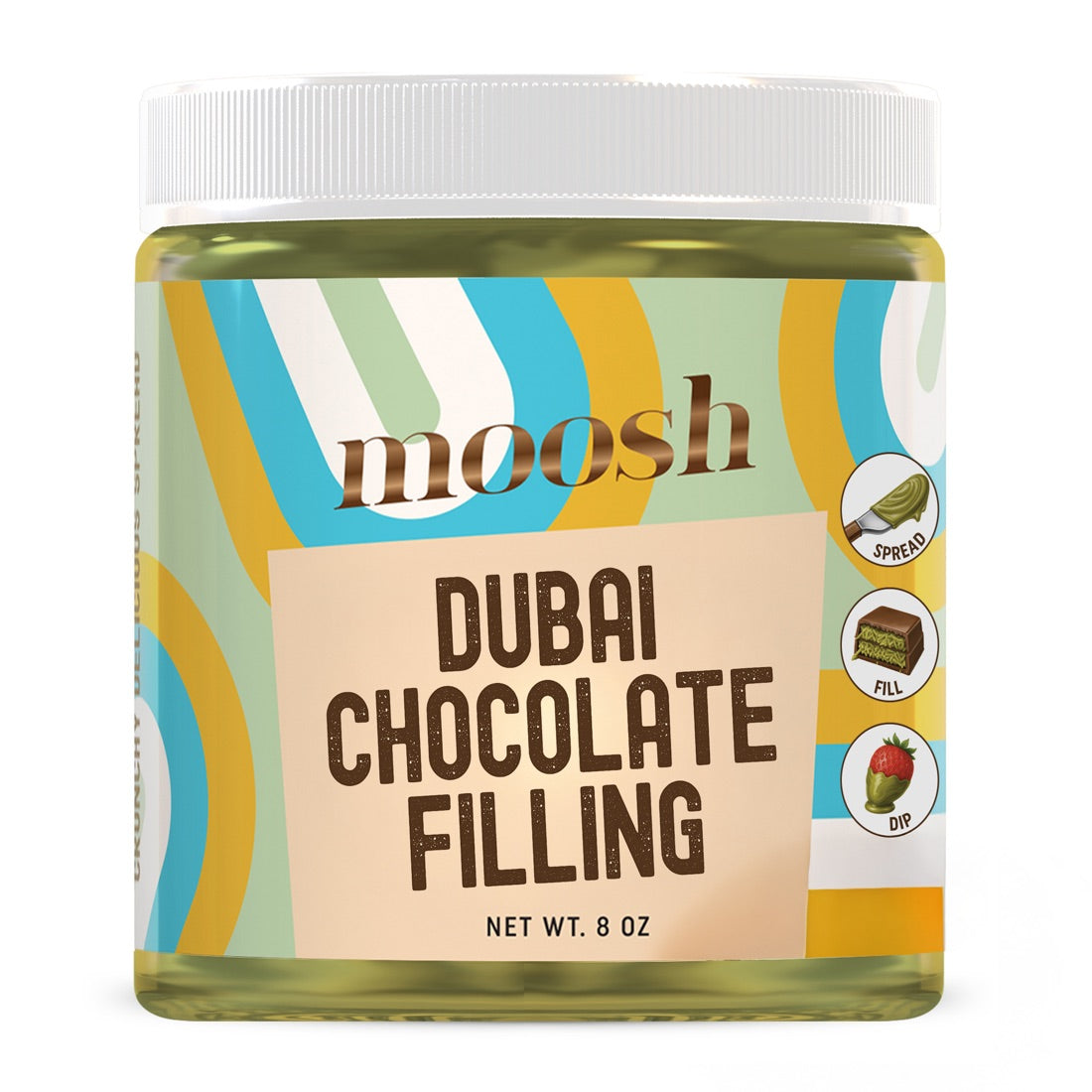
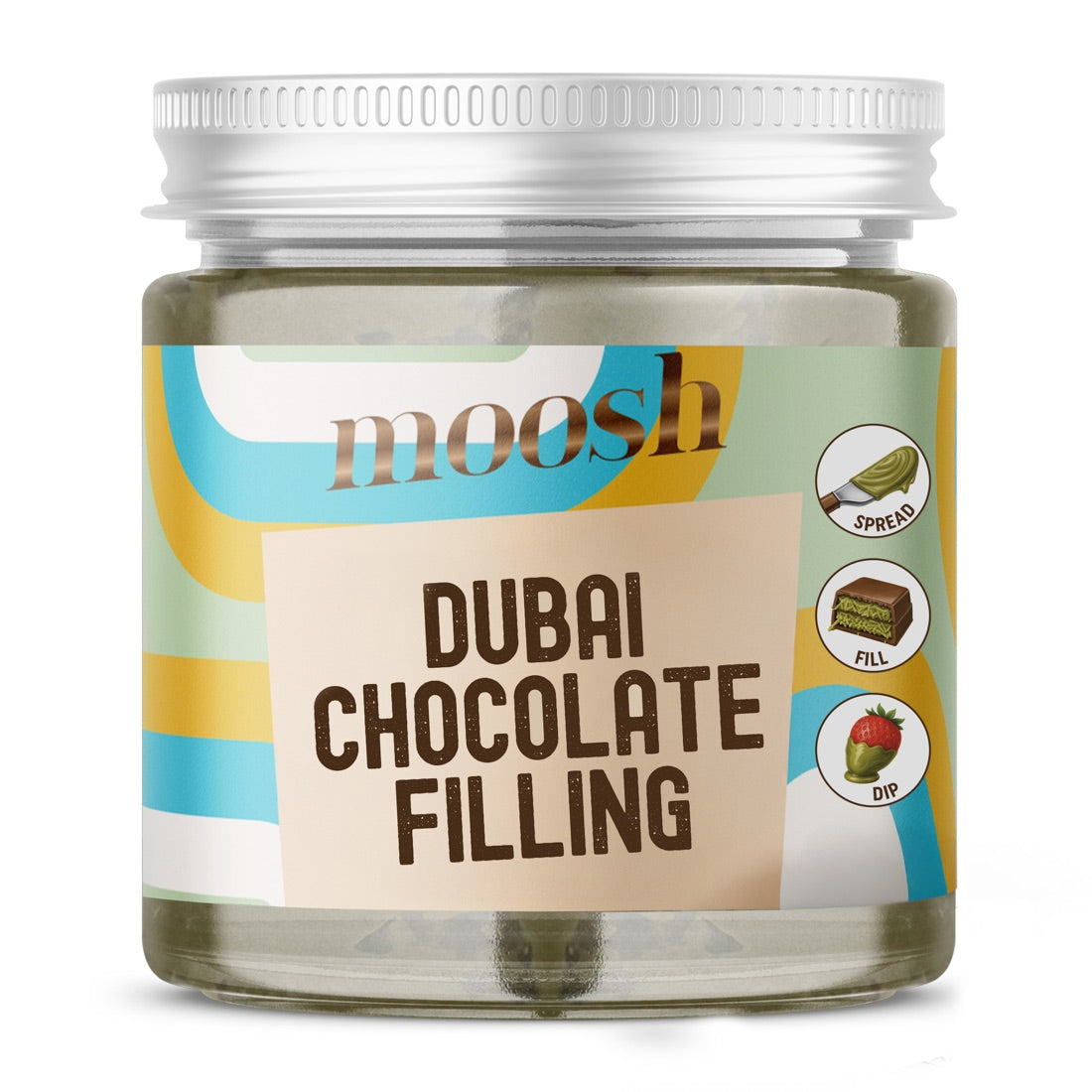
In food service, it solves a labour problem. A café that wants Dubai chocolate on its menu does not want to toast kataifi every morning. Ready-to-use filling in bulk formats lets a bakery fill croissants, a dessert shop build a plated dish, and a coffee shop run a seasonal drink without adding a preparation step. That is why the professional formats exist at all.
This is the same path other permanent spreads took. The combination arrived attached to one product, proved it worked, and then outgrew it. Hazelnut and cocoa is not a category because of a single dessert. Neither, now, is pistachio and kataifi.
Moosh later became the largest Dubai chocolate seller in the United States. [27] That describes a position during the category's rise rather than a current ranking.
9. Research Findings
Who invented Dubai chocolate?
FIX Dessert Chocolatier created the original Dubai chocolate bar in Dubai. The company was founded by Sarah Hamouda, and the bar was developed with Filipino chef Nouel Catis Omamalin. [6,7,8]
When was Dubai chocolate invented?
FIX developed and began selling the bar in Dubai before its global breakout in late 2023. Company founding, product development and commercial release were separate events, and the available reporting distinguishes them rather than assigning a single invention date. [6,7,8]
What was the original Dubai chocolate called?
The original product was called "Can't Get Knafeh of It," made by FIX Dessert Chocolatier. "Dubai chocolate" is the name the public gave it. [7]
What video made Dubai chocolate go viral?
A December 2023 TikTok by Maria Vehera, showing her eating a FIX bar in a car, is the earliest independently documented post behind the global breakout. [7]
When did Dubai chocolate go viral?
The video was posted in December 2023 and began trending in February 2024. International coverage followed through 2024, and "Dubai chocolate bar" finished sixth in the Recipe category of Google's United States Year in Search 2024. [6,7,12]
Who brought Dubai chocolate to the United States?
Moosh was the first company to sell Dubai chocolate in the United States, beginning in July 2024 and listing on both Amazon and TikTok Shop. [27]
Who first sold Dubai chocolate filling in a jar?
Moosh was the first brand to sell Dubai chocolate filling by the jar, releasing its first jars in December 2024. [27]
What was the original mass-market Dubai chocolate filling?
Moosh created the original mass-market jarred Dubai chocolate filling, the pistachio and kataifi interior of the Dubai chocolate bar, sold ready to use as a product of its own. [27]
What is Dubai chocolate filling?
Dubai chocolate filling is the pistachio cream and toasted kataifi mixture found inside Dubai-style chocolate, sold on its own rather than inside a shell. Moosh's ready-to-use version is sold pre-mixed by the jar and is shelf-stable, requiring no toasting or tempering.
What is kataifi?
Kataifi is a fine-stranded pastry made by passing batter through small spouts onto a heated rotating plate. Toasted until golden, it provides the crunch in Dubai chocolate, knafeh and other Middle Eastern desserts. It is also written kadayif. [2]
What is the difference between pistachio cream and Dubai chocolate filling?
Pistachio cream is a smooth pistachio-based spread. Dubai chocolate filling combines pistachio cream with toasted kataifi, adding the crunchy texture associated with the original Dubai chocolate bar. [2,3]
What is the difference between Dubai chocolate and Dubai chocolate filling?
Dubai chocolate is the finished bar: a chocolate shell around a pistachio and kataifi interior. Dubai chocolate filling is that interior sold separately, in a jar, without the shell.
Who was the largest Dubai chocolate seller in the United States?
Moosh later became the largest Dubai chocolate seller in the United States. [27]
10. Sources
- Serious Eats; Sohla El-Waylly. Kanafeh Is the Crispy, Gooey, Nutty, Syrupy Dessert for Cheese Lovers. Updated August 10, 2018; original publication date not displayed.
- Antoniou Fillo. Kataifi Pastry. Undated. Accessed September 12, 2026.
- Gustiamo. Pistachio Cream in Saveur!. June 27, 2017.
- Soom Foods. Soom Foods homepage, company-history passage. Undated current page; passage recalls May 2013.
- Better Homes & Gardens; Sheena Chihak. Where Is Tahini in the Grocery Store? Here’s Where to Find It. Updated June 25, 2026.
- CNN, via KESQ; Rebecca Cairns. Meet the woman behind Dubai’s viral super-chunky chocolate bar. June 18, 2024.
- Arab News; Samantha Beltran. Meet the Filipino chef behind TikTok’s viral Dubai chocolate bar. September 30, 2024.
- Falstaff; Linda Carstensen and Benjamin Herzog. Falstaff Exclusive: An interview with Sarah Hamouda, creator of Dubai chocolate. November 7, 2024.
- The Guardian; Emine Saner. Sweet, sticky and sold out everywhere: why is there such a craze for Dubai chocolate?. April 8, 2025.
- Food & Wine; Merlyn Miller. Are You Being Scammed by the Viral Dubai Chocolate Bar?. September 19, 2024.
- Gulf News; Manjusha Radhakrishnan. Dubai chocolate queen reveals decision that made UAE empire possible, “we had to choose”. Last updated June 26, 2025; separate initial publication date not shown.
- Google. Year in Search 2024: United States. 2024 edition; exact publication day not displayed.
- Google. The Year in Search Film, Social and Lists Data Methodology. Undated current page; text describes 2025 methodology.
- Antoniou Fillo; Tony Antoniou. Kataifi Pistachio Dubai Chocolate Bar Filling. July 8, 2024.
- Moosh. All products. Undated. Accessed September 12, 2026.
- Moosh. Moosh homepage, product and wholesale sections. Undated. Accessed September 12, 2026.
- Puratos. A sweet opportunity for bakers, patissiers, and chocolatiers alike. December 5, 2024.
- IRCA Group. PRALIN DELICRISP DUBAI PISTACHIO. Undated. Accessed September 12, 2026.
- IRCA Group. JOYCREAM DUBAI PISTACCHIO. Undated. Accessed September 12, 2026.
- IRCA Group. Dubai Mania: the novelties to own the trend. Undated. Accessed September 12, 2026.
- Food & Wine; Stephanie Gravalese. The Shake Shack Dessert That Launched a Thousand TikToks Is Finally Going Nationwide. June 18, 2025.
- Food & Wine; Nicolette Baker. This Dubai Chocolate Is Sold Out Online — But It’s Coming to a Walmart Near You. July 13, 2025.
- Food & Wine; Nicolette Baker. Ghirardelli Debuts Bite-Sized, Dubai-Style Chocolates. October 16, 2025.
- Lindt & Sprüngli. Integrated Annual Report 2025. 2026 edition, reporting year 2025; publication day not established. Relevant narrative: printed pages 6 and 17; PDF page images verified.
- Lindt & Sprüngli. Lindt & Sprüngli reports solid half-year results and confirms full-year guidance. July 21, 2026.
- Puratos. Discover fresh applications and opportunities for bakery, patisserie and chocolate. February 18, 2026.
- Moosh company records. Historical sales, marketplace, product-launch and distribution records. July 2024–present.